Why a Clear Route Changes the Feel of a Room
A clear route through a room makes everyday movement easier. Learn what to trace, where paths conflict with activities, and how to judge a furniture change.
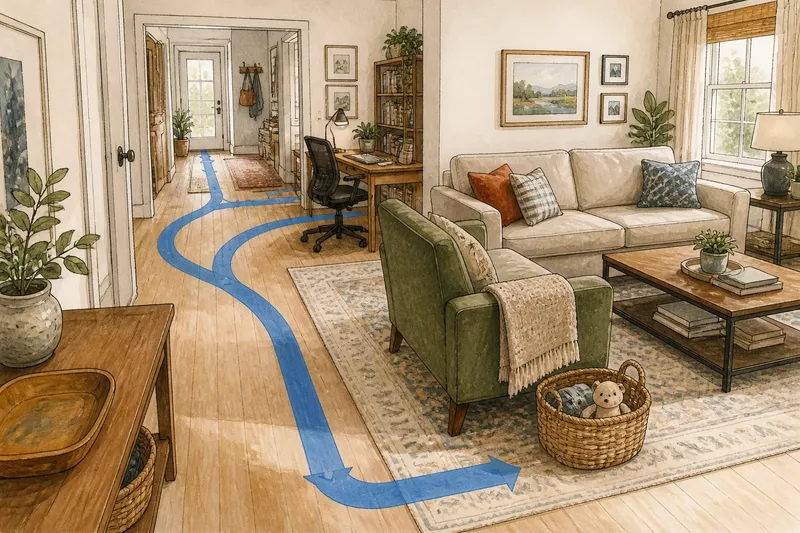
You carry a mug from the kitchen, turn around the sofa, and pause to let someone pass. That small detour shows why a clear route through a room matters: it connects the entrance with the places people use without repeatedly interrupting them.
A route is a pattern of use, not a line on a plan
Rooms can look orderly from the doorway while making ordinary movement awkward. A chair may be easy to admire but hard to pass. A side table may sit precisely where someone turns toward a window. To see how the room works, pay attention to repeated actions rather than judging furniture in isolation.
Think of a route as a ribbon laid across the floor. It can bend around an obstacle, but each extra bend changes the way someone moves. In a room, that bend might mean squeezing between a coffee table and sofa, stepping around a toy basket, or turning sideways beside a desk.
A useful route connects entrances with everyday destinations: a seat, closet, desk, window, or exit. It does not have to be perfectly straight. It should feel natural for the people who use the room, including someone carrying laundry or walking through while another person is seated.
Notice where movement slows or changes direction
Identify the room’s main entry points and the places people visit repeatedly. Then notice what happens between them. Does someone take a shortcut behind a chair? Does a person move a footstool before opening a cabinet? Does crossing the room interrupt someone reading or working?
A detour is not automatically a problem. A table may need to sit near a sofa, and a doorway may open into a tight corner. Ask whether the detour adds friction to an action that happens often or creates an awkward crossing the room could avoid.
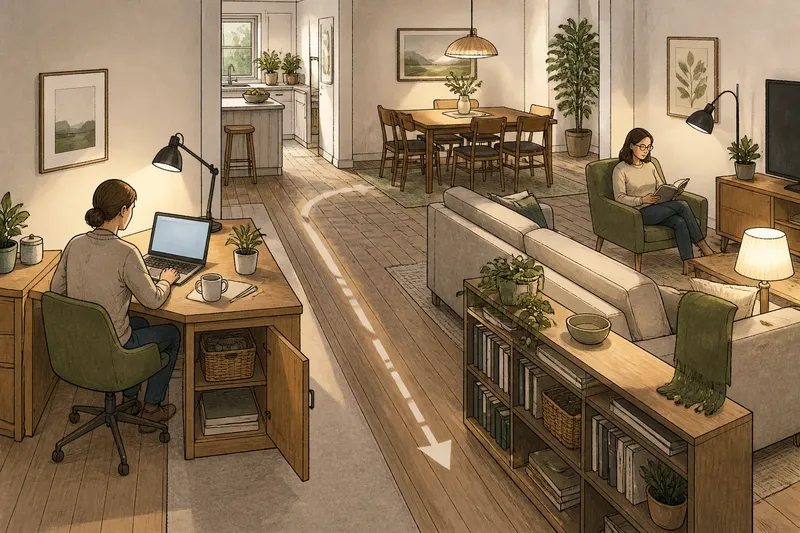
Routes can also conflict with different uses of a room. In a shared living room, one person may head for the couch while another passes through to a bedroom. If the only path cuts directly across the seating area, movement can make the room feel unsettled even when no object is physically in the way.
Trace the routes people actually take before moving furniture
During ordinary use, observe movement without asking anyone to change their habits. Sketch the room, mark doorways and large furniture, and draw arrows along the paths people take. Use a different mark for frequent trips, such as walking between a bedroom and closet, and occasional ones, such as reaching a window.
Keep the sketch practical rather than precise. Mark where someone turns, pauses, reaches around an object, or passes close to a seated person. Painter’s tape can represent a proposed route while the existing furniture stays in place. Check that the taped path connects to each destination rather than ending at the furniture.
Say someone carrying a laundry basket leaves the bedroom, turns around an armchair, and squeezes between the coffee table and sofa on the way to the hall. They move the chair toward a wall and lay painter’s tape along a more direct path. The expected result is a route without the sharp turn or squeeze; if the tape now crosses a frequently used seat, the change has moved the conflict rather than resolved it.
Check the route during different ordinary activities. A path that works when the room is empty may not work when a desk chair is pulled out or a cabinet door is open. The aim is to understand the room in use, not only in its tidiest arrangement.
Judge a route by its crossings and destinations
As you trace a route, check each crossing and the full action at its destination. Use this list to turn observations into a decision:
- Check whether the route repeatedly cuts through a seated person’s space. If it does, try an approach around the seating; if no alternate route fits, discuss whether the seating or passage should take priority.
- Check whether two frequent routes meet at a narrow passage. If people regularly stop or turn aside there, test moving a small table or angling a chair; if the crossing remains awkward, preserve the clearest route for the most-used destinations and reconsider the others’ approach.
- Check whether a doorway or cabinet door opens into the route. If it blocks passage when open, shift a movable item or trace a route that allows the door to open; if neither works, keep the doorway area clear and reassess the furniture placement.
- Check whether someone must squeeze, turn sideways, or reach around furniture. If that happens repeatedly, test a more direct path with tape; if the new path disrupts another activity, try a different item or angle instead.
- Check whether the destination can be used after someone reaches it, including room to sit, stand, or open a drawer. If the final action is cramped, adjust the nearby furniture; if that blocks another route, compare which use is more frequent before settling on a placement.
- Check whether a desk chair, footstool, or basket changes the path during ordinary use. If it does, include that item in the route sketch and test the arrangement with it in place; if it cannot stay out of the way, choose a storage spot that does not obstruct a common passage.
Destinations matter as much as the route. A clear approach to a chair is useful only if there is room to sit down and stand up. A path to a cabinet should allow its door or drawer to open. Trace the whole action, including the space needed to use the destination, rather than stopping the sketch at the object.
Make one small change and watch what it changes
When a route seems awkward, change one movable item at a time. Shift a basket, turn a small table, or reposition a chair, then repeat the movement that revealed the problem. With one change, it is easier to see whether the detour improved and whether a new conflict appeared.
Keep practical needs in view. A route should not block a door, cover a vent, or leave a walkway cluttered with cords. If placement depends on a product label, manufacturer instructions, or local rules, follow that guidance. In a shared home, include the people who use the room; one person’s shortcut may be another person’s comfortable boundary.
What should you look for as you trace a route?
Which paths should I trace first?
Start with repeated trips between entrances and everyday destinations, such as a seat, desk, or closet. Add occasional routes afterward so the most common movement remains your main consideration.
Should every route be straight?
No. A gentle turn can fit the room and its activities, while a direct path may cut through someone’s work or rest area. Notice whether the route feels natural and avoids unnecessary squeezes.
How can I tell whether furniture is causing a problem?
Watch for repeated detours, pauses, side-stepping, or objects people move aside each time they pass. A recurring adjustment points to a route worth reconsidering, even if one awkward moment might be incidental.
What if people use the room in different ways?
Trace each person’s common route and mark where paths overlap. Look for an arrangement that preserves access for both without sending one person through another’s main activity.
A clear route through a room is easiest to judge while the room is being used: the mug is carried, the drawer is opened, and someone else walks past. Check the destination as carefully as the passage; a path is only useful if the person can complete the task once they arrive.